


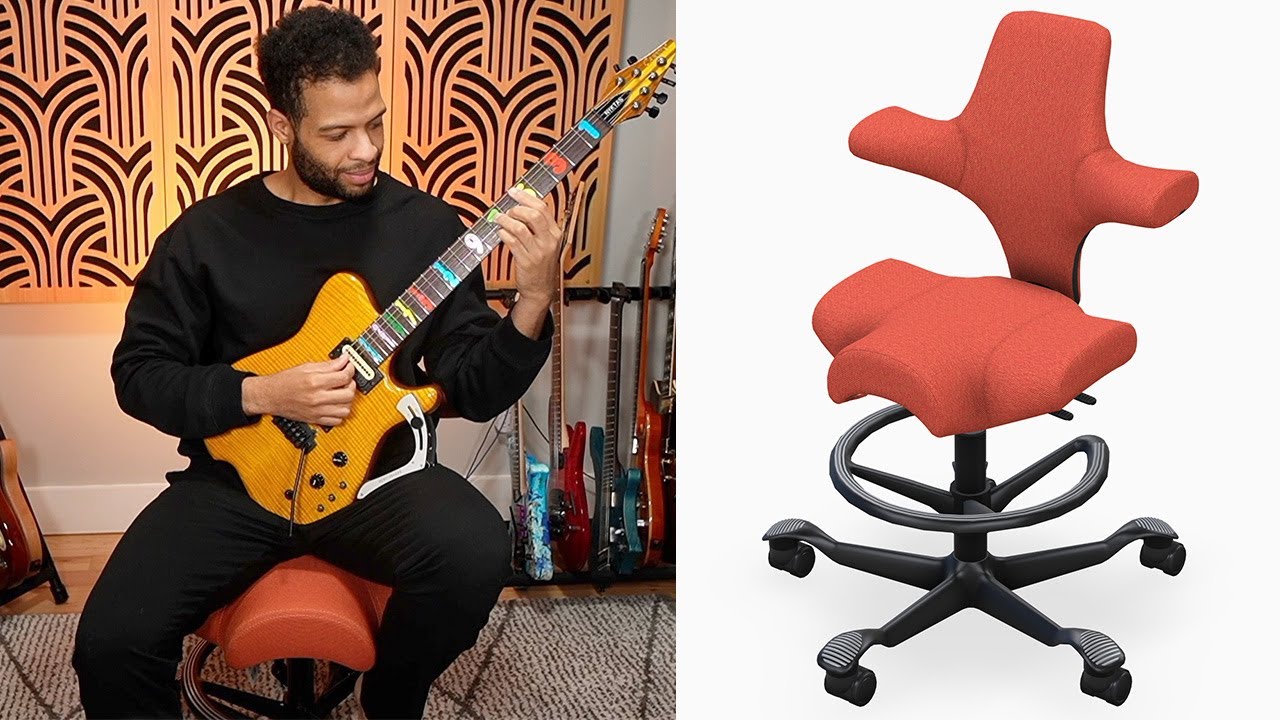
Musicians spend hours seated in positions that most office chairs were never designed to support. A guitarist leans forward with arms extended. A pianist needs unrestricted arm movement with a stable, balanced core. A producer hunches over a mixing desk for 12-hour sessions. The HAG Capisco has become the chair of choice for professional musicians because its saddle seat and open design solve problems that conventional chairs create.
Why standard chairs fail musicians
A typical office chair has armrests that block guitar positioning, a backrest that pushes you forward into a slouch when you lean to play, and a flat seat that tilts your pelvis backward. For musicians, this means:
- Restricted arm and shoulder movement
- Lower back pain after long practice sessions
- Compressed breathing from a closed chest position
- Neck strain from compensating for poor pelvic position
- Numbness in the legs from seat edge pressure
The Capisco eliminates every one of these issues through its fundamental design principle. The saddle seat opens the hip angle well beyond the 90 degrees a conventional flat seat forces, which naturally aligns the spine and frees the upper body to move without restriction. This concept of active sitting is crucial for anyone who needs to maintain focus and physical comfort over long periods.
For guitarists: unrestricted access
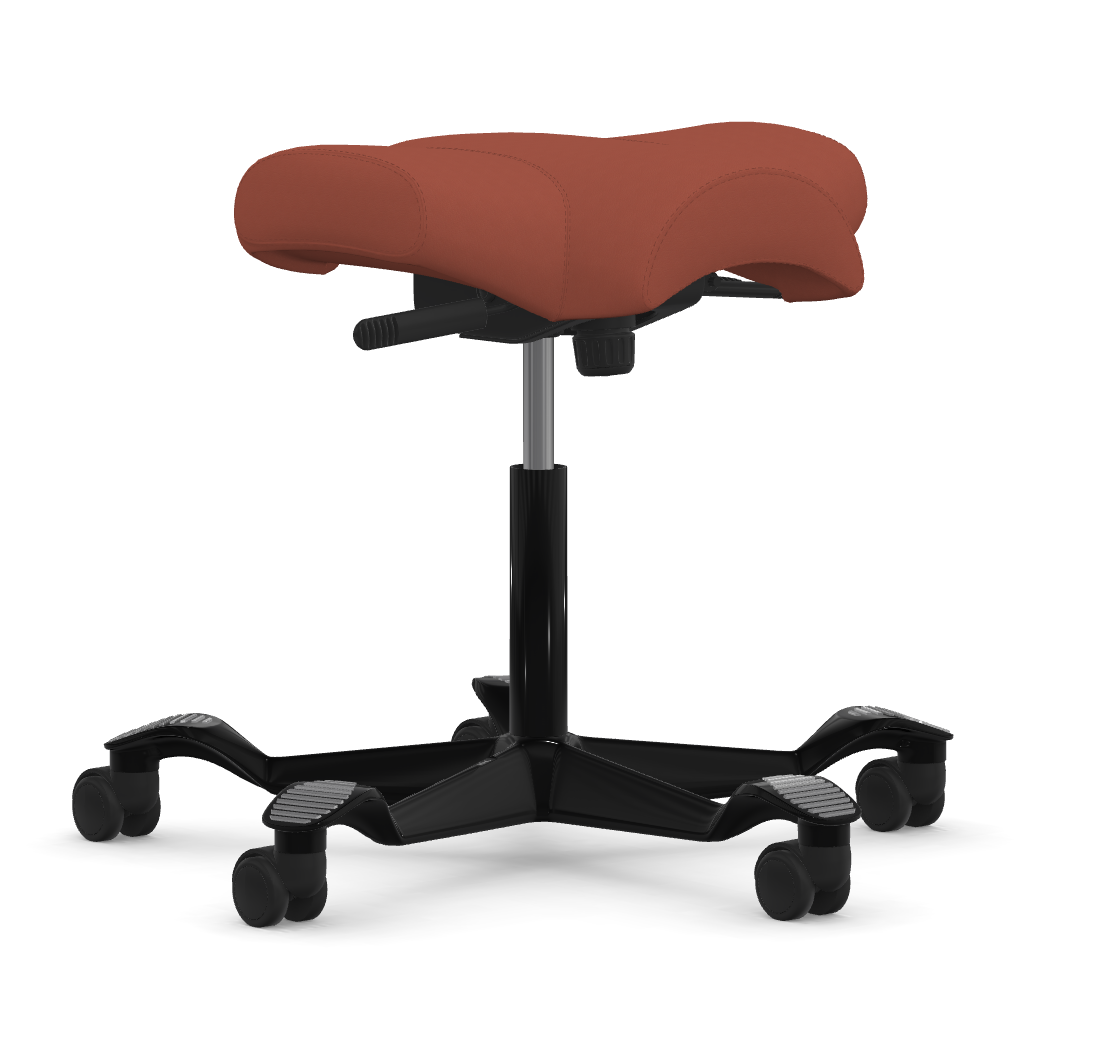 The Capisco 8105 saddle stool gives guitarists complete freedom of movement with no armrests or obstructions.
The Capisco's saddle seat positions your thighs at a downward angle, creating space for the guitar body to rest naturally against your leg without you having to lift or twist. There are no armrests to collide with your strumming arm. You can sit facing forward in classical position, or straddle the seat and lean into the backrest for a more relaxed playing style.
The height adjustability is particularly valuable for guitarists. You can set the seat higher for a more upright, performance-ready position, or lower for a relaxed practice session. On the backless 8105 the 150mm gas lift gives a seat height of 380 to 520mm, the 200mm lift gives 440 to 620mm, and the 265mm lift gives 530 to 790mm. The same chair works whether you are playing acoustic, electric, or bass. If you are working at standing-desk or bench height, a HAG Capisco FootRing gives your feet somewhere to sit, though note it fits the 200mm and 265mm lifts only and cannot be added to a 150mm lift.
For pianists and keyboard players: stable core, free arms
Piano technique demands a stable, balanced torso with completely free arm movement from the shoulder. The saddle seat provides exactly this. Your pelvis is tilted slightly forward, your spine stacks naturally, and your core engages just enough to maintain balance without tension. Your arms hang freely from relaxed shoulders.
Unlike a piano bench, the Capisco provides back support when you need a rest between pieces, and the height adjustment means you can find the exact relationship between your body and the keyboard that your technique requires. Many pianists find that the open hip angle actually improves their pedal reach and control as well. For a comprehensive look at how the Capisco compares to other premium options, you might want to read our Herman Miller vs HAG comparison.
For producers and studio engineers: marathon sessions
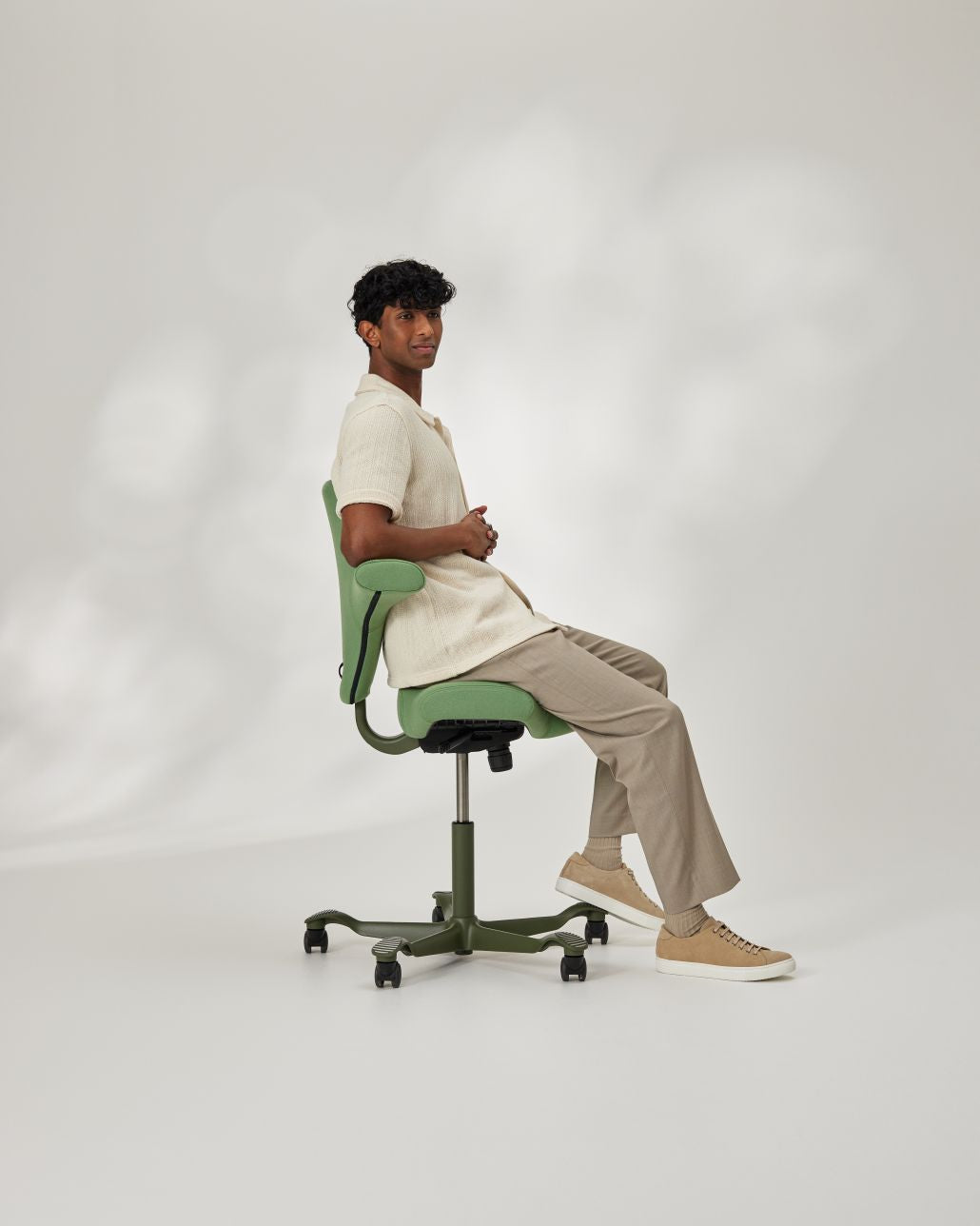 The forward lean position keeps the spine neutral during long mixing sessions.
Music producers and recording engineers face a specific challenge. They need to lean forward toward a mixing desk or screen for extended periods, often 8 to 12 hours in a session. The Capisco's design actively supports this forward-leaning posture. You can sit reversed, leaning your chest against the backrest while reaching forward to the desk. Or sit conventionally with the seat tilted forward, maintaining spinal alignment even as you lean in to adjust a fader.
If your sessions regularly run past nine hours a day, note that the HÅG warranty is 10 years for use up to nine hours a day and 5 years beyond that, with fabrics and leather covered for 5 years.
The constant position changes that the Capisco encourages also prevent the fatigue and stiffness that derails concentration during long studio sessions. When your body is comfortable and moving, your ears stay fresh longer. If you are setting up a new studio, pairing your Capisco with one of our Sit to Stand Desks can further enhance your ergonomic setup.
Comparing the Capisco models for musicians
Choosing the right Capisco model depends on your specific needs as a musician. Here is a breakdown of the key differences to help you decide.
| Feature | Capisco 8105 (Stool) | Capisco 8106 (Classic) | Capisco Puls 8010 |
|---|---|---|---|
| Backrest | None | Yes, cross-shaped | Yes, cross-shaped |
| Seat Material | Fully upholstered | Fully upholstered | Moulded polypropylene (PP) seat and backrest with an integrated seat cushion |
| Chair weight | 7.4 kg | 12.1 kg | 11.1 kg |
| Seat height, 200mm lift | 440 to 620mm | 460 to 640mm | 455 to 640mm |
| Best For | Performers, short practice sessions | Long practice sessions, studio work | Studios needing easy-clean surfaces |
| Freedom of Movement | Maximum | High | High |
The Capisco 8105 is the backless saddle stool version, preferred by performers who want zero obstruction and maximum freedom. At 7.4kg it is the lightest chair in the range, which matters if you move it between a practice room and a stage. A FootRing can be added if you order it with a 200mm or 265mm gas lift.
The Capisco 8106 adds the distinctive back support, which is better for long practice sessions and studio work where you need occasional rest. The back is low enough that it never interferes with arm movement, but high enough to lean against during breaks.
The Capisco Puls 8010 offers the same saddle posture on an easy-clean moulded polypropylene (PP) seat and backrest, with an integrated seat cushion, which is practical for studios where drinks and equipment are everywhere. It is a separate chair from the 8106 with its own published dimensions, not a trim level of it. For a deeper dive into the different models, check out our complete guide to HAG ergonomic chairs.
Customising your Capisco for the studio
To get the most out of your Capisco in a music setting, you need to configure it correctly. The gas lift height is crucial. The 150mm lift works well for most standard desk setups, but if you play standing up occasionally or use a high drafting table, you will want the 200mm or 265mm lift. Read our HAG Capisco gas lift guide to ensure you choose the right height.
Additionally, consider the floor surface in your studio. If you have hard floors, you will want soft castors to prevent damage and ensure smooth rolling. If you are on carpet, hard castors are better. We offer replacement HAG Capisco Castors to suit any environment. If you prefer your chair to stay put while you play, HAG Capisco Glides are an excellent alternative to wheels.
What musicians say
The Capisco has developed a genuine following in the music community. Guitarists on forums consistently report that back pain they attributed to playing was actually caused by their chair. Pianists describe improved technique from the open hip position. Producers say they can work longer without the physical fatigue that used to end their sessions early.
The chair does not make you a better musician. But it removes the physical barriers that prevent you from practising as long and as comfortably as your craft demands. It is an investment in your physical health and your musical longevity.
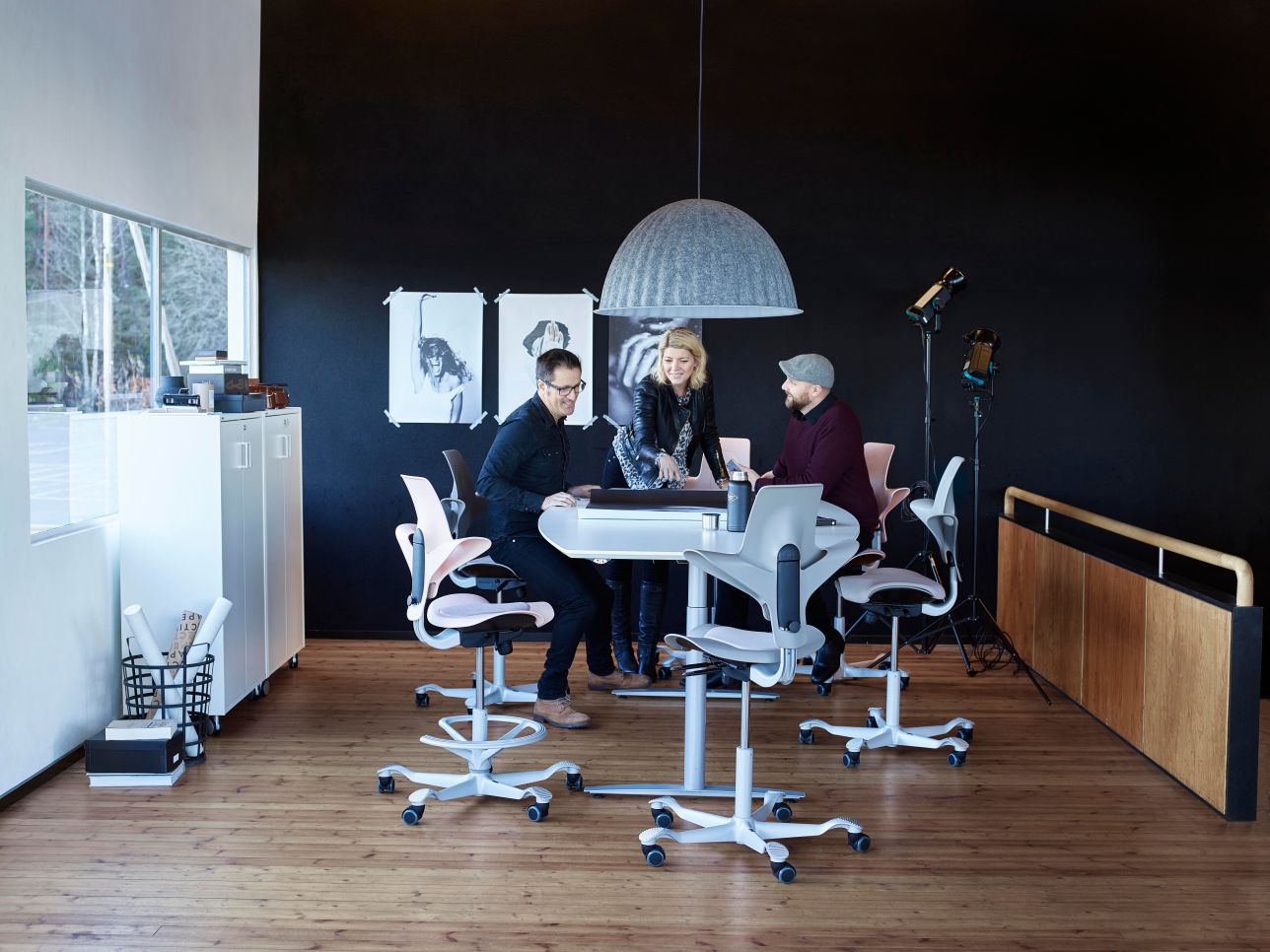 The Capisco in a creative workspace. The same chair works for music production, design, and general work.
Frequently Asked Questions
Is the HAG Capisco good for playing acoustic guitar?
Yes, the HAG Capisco is excellent for playing acoustic guitar. The saddle seat design allows your legs to drop naturally, creating ample space for the body of an acoustic guitar. The lack of armrests means your strumming arm has complete freedom of movement, preventing the awkward posture often required when playing in standard office chairs.
Can I use the Capisco as a piano stool?
Absolutely. Many pianists prefer the Capisco over traditional piano benches. The saddle seat promotes a forward pelvic tilt, which naturally aligns the spine and engages the core. This stable base allows for free arm movement and better reach across the keyboard, while the optional backrest provides support during breaks.
Which Capisco model is best for a recording studio?
For a recording studio, the Capisco 8106 is generally the best choice. It offers the core benefits of the saddle seat while providing a backrest for support during long mixing sessions. The unique cross-shaped backrest allows you to sit backwards and lean your chest against it, which is ideal for leaning over a mixing console.
How does the Capisco change the way you sit while playing?
The Capisco opens the hip angle well beyond the 90 degrees of a conventional seat. That geometry lets you sit upright, perch forward over the instrument, or straddle the seat and lean into the backrest, and swap between those positions as often as you like. Many players simply prefer it to a flat stool for long practice sessions.
Should I get the Capisco with or without a footring?
A FootRing is highly recommended if you are using a 200mm or 265mm gas lift or a sit-to-stand desk. It provides a comfortable place to rest your feet and vary your leg position, which is essential for maintaining circulation and comfort during extended periods of sitting or perching. It does not fit the 150mm lift, so if you are on a standard fixed-height desk you will be using the grooved footplates on the chair base instead.
Upgrade your practice space today
Do not let a poor chair limit your musical potential. The HAG Capisco offers the support, freedom, and versatility that musicians need to perform at their best. Chair Dinkum is the exclusive Australian distributor for the Flokk group, of which HAG is one of eleven brands. Explore our range of HAG Capisco Saddle Chairs and find the perfect fit for your studio or practice room. If you have any questions about configuring your chair, please contact us for expert advice.


