


The HAG Capisco is offered with three gas lifts, not two: 150mm, 200mm and 265mm. The gas lift is the single decision that determines how high and how low your chair will go, which desks it will work with, and whether you can use the Capisco's perching position at all. It is also the one part most often ordered wrong, because almost every guide online — including the chair's own resellers — still describes only two options.
This guide gives the seat height range of every current Capisco model against every gas lift, taken from Flokk's current HAG Capisco factsheet, explains how those heights are measured, and gives you a method for working out which lift you need before you order.
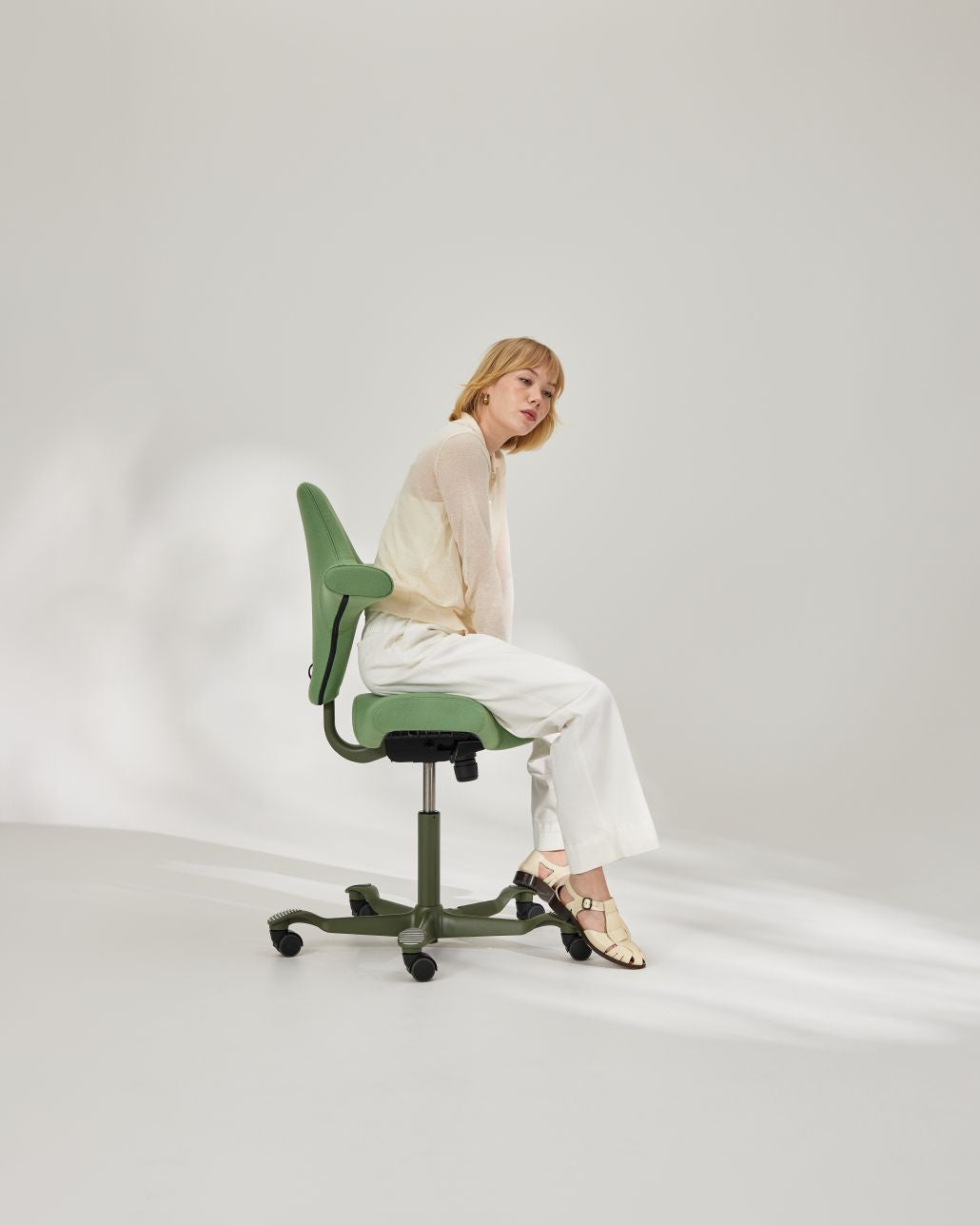 The Capisco supports seated, forward-leaning, reversed and perched positions. Which of those you can actually reach depends on the gas lift fitted.
The short answer
- 150mm gas lift — the low option. Choose it if you are shorter, sit at a fixed low desk, or have found that a 200mm lift will not drop far enough for your feet to rest flat on the floor.
- 200mm gas lift — the standard. It suits the typical Australian fixed-height desk of about 72cm and covers ordinary seated and forward-leaning work.
- 265mm gas lift — the high option. Choose it for sit-stand desks, drafting tables, lab and clinical benches, and for anyone who wants to perch in a semi-standing position.
If you are between two lifts, the deciding factor is almost always the lowest height you need, not the highest — a chair that will not go low enough is unusable, while a chair that will not go quite high enough is merely limited.
Buying a Capisco Puls rather than a Capisco? Stop here and read the HAG Capisco Puls gas lift guide instead. The Puls has its own factsheet and not one seat height on this page applies to it.
Seat height by model and gas lift
Seat heights differ between Capisco models because the seat forms differ. The backless 8105 sits about 20mm lower than the rest of the range across every lift. The figures below are the current published ranges, converted from the centimetre figures Flokk publishes.
| Model | 150mm gas lift | 200mm gas lift | 265mm gas lift |
|---|---|---|---|
| 8105 — backless | 380 – 520mm | 440 – 620mm | 530 – 790mm |
| 8106 — standard upholstered back | 400 – 540mm | 460 – 640mm | 550 – 810mm |
| 8107 — as 8106, with headrest | 400 – 540mm | 460 – 640mm | 550 – 810mm |
| 8126 — alternative seat form | 400 – 540mm | 460 – 640mm | 550 – 810mm |
| 8127 — as 8126, with headrest | 400 – 540mm | 460 – 640mm | 550 – 810mm |
In centimetres, as Flokk publishes them: the 8105 runs 38–52cm, 44–62cm and 53–79cm; the 8106, 8107, 8126 and 8127 all run 40–54cm, 46–64cm and 55–81cm.
This guide is about seat height. For the rest of the specification — seat and backrest dimensions, chair weights, materials, certifications and warranty conditions, model by model — see our HAG Capisco models and measurements page.
Two things follow from this table that are worth stating plainly. First, the 200mm lift on an 8106 tops out at 640mm, not 655mm as is widely repeated. Second, the 265mm lift starts at 550mm, not 555mm. Those are small differences on paper and large ones when you are trying to work out whether a chair will reach your bench.
How these seat heights are measured — and why your tape measure may disagree
This is the part almost every guide leaves out, and it explains most of the confusion people have when their new chair does not measure what the specification says.
Published seat heights for office chairs are measured with a load on the seat. Test methods apply a weighted load of roughly 64–65kg to the seat before the height is taken, because a gas lift compresses slightly under an occupant. Flokk footnotes its own loading condition on the Capisco factsheet.
The practical consequences:
- An unloaded chair — one you measure in a showroom or in your living room before you sit on it — will read slightly higher than the published figure.
- A difference of a centimetre or two between the spec sheet and your tape measure is normal and is not a fault.
- If you are heavier than the test load, expect your seated height to settle marginally lower than published; if you are lighter, marginally higher.
- Because of this, do not choose a lift on a margin of 10mm. If your required seat height sits within about 20mm of the top or bottom of a lift's range, choose the lift that gives you room to move.
The 150mm gas lift
The 150mm lift is the option that is missing from nearly every comparison online, and it is the right answer more often than you would think. It gives 400 to 540mm on an 8106, 8107, 8126 or 8127, and 380 to 520mm on the backless 8105.
That 380–400mm minimum is genuinely low. It is the answer for:
- Shorter users who need their feet flat on the floor and find the 200mm lift's 460mm minimum still leaves their heels hanging.
- Low fixed desks, including older Australian office desks and many dining-height or console-height home setups below 70cm.
- Younger users and study desks, where the chair has to come down a long way.
- Anyone who has bought a Capisco with a 200mm lift and found it will not go low enough — swapping to a 150mm lift solves it without replacing the chair.
The trade-off is at the top. A 150mm lift stops at 540mm, so perching, standing-height benches and raised sit-stand positions are out of reach. It is a lift for sitting, not for perching.
One constraint to note before you choose it: the HAG FootRing does not fit the 150mm gas lift. The FootRing is available for chairs with 200mm and 265mm lifts only. If a footring matters to you, the 150mm lift is not an option — but at these seat heights you should not need one, because your feet reach the floor.
The 200mm gas lift — the standard
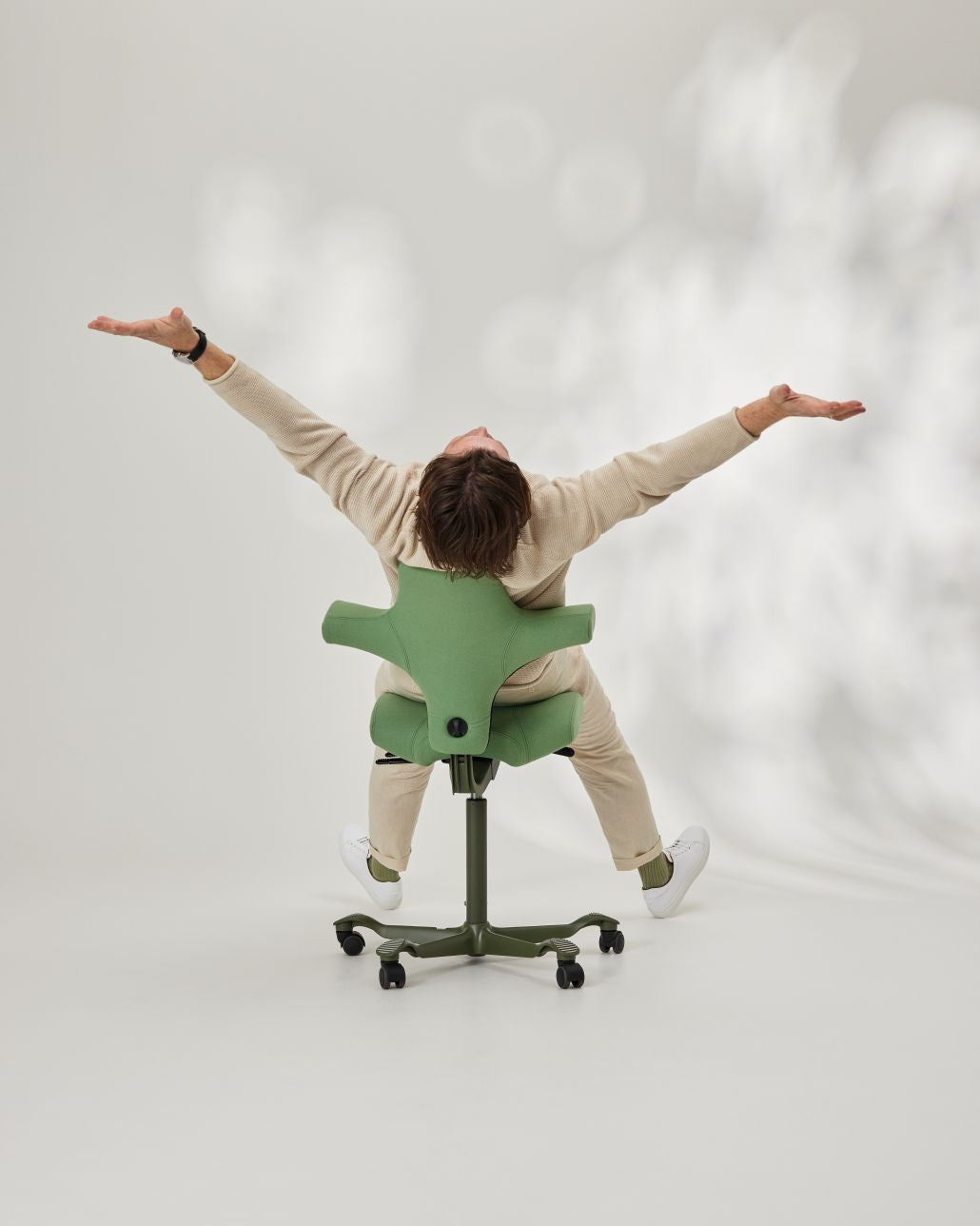 The 200mm gas lift covers the conventional seated range at a standard 72cm desk.
The 200mm lift gives 460 to 640mm on an 8106, 8107, 8126 or 8127, and 440 to 620mm on the 8105. This is the lift most Capisco chairs are sold with, and for a fixed-height Australian office desk of around 72cm it is the correct default.
It covers the full range of conventional Capisco use: sitting forward with the pelvis tilted over the saddle, sitting back against the shaped backrest, and sitting reversed with your chest against the back — the position the Capisco is best known for. The balanced tilt works normally across the whole range.
Choose the 200mm gas lift if:
- Your desk is fixed at roughly 70 to 75cm and will stay that way
- Your working seat height lands somewhere between about 480 and 620mm
- You sit rather than perch, and want the chair to also drop low enough for relaxed reading or reversed sitting
- You want the option of a FootRing later without changing the lift
Its limit is 640mm. If you own or expect to own a sit-stand desk, the 200mm lift will let you sit at the desk's lowest settings but will not follow it up. That is the single most common reason people replace a gas lift after purchase.
The 265mm gas lift — the high option
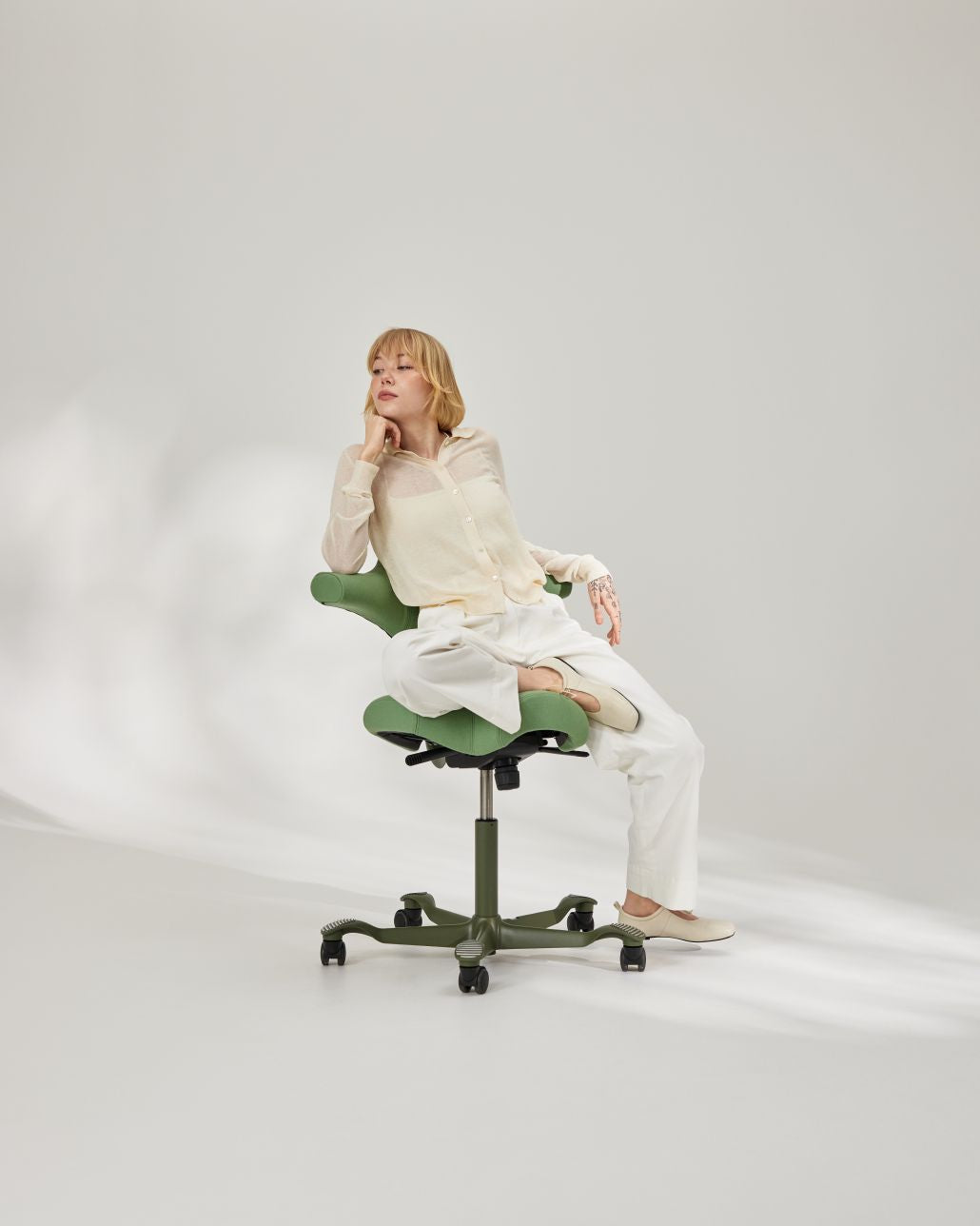 The 265mm gas lift reaches perching height, letting you work semi-standing at a raised desk.
The 265mm lift gives 550 to 810mm on an 8106, 8107, 8126 or 8127, and 530 to 790mm on the 8105. At 810mm the seat is high enough to perch against at a fully raised standing desk, with your weight shared between the saddle and your feet.
This is the lift that unlocks the way the Capisco was designed to be used across a whole day: sitting low for concentrated desk work, then raising the seat and the desk together and perching for a period, then coming back down. You are not choosing between sitting and standing; you are moving between them.
Choose the 265mm gas lift if:
- You use a height-adjustable sit-stand desk, or intend to buy one
- You work at a raised bench — dental, medical, laboratory, workshop, salon, retail counter
- You use a drafting table, easel, or a standing-height kitchen or studio bench
- You want to alternate between seated and perched positions through the day
Its limit is at the bottom: 550mm. If you are shorter, or you also want to drop the chair low for reversed or relaxed sitting, 550mm may already be higher than you want. This is where a FootRing earns its place — it gives you somewhere to put your feet when the seat is above your comfortable floor-reach height.
Where the ranges overlap
The three ranges are not separate bands; they overlap, which is why more than one lift can be technically correct for the same person. On an 8106:
- The 150mm and 200mm lifts overlap between 460 and 540mm
- The 200mm and 265mm lifts overlap between 550 and 640mm
- There is no seat height at which all three lifts overlap
On the backless 8105 the overlaps sit 20mm lower: 440 to 520mm, and 530 to 620mm.
If your required seat height falls in the 550–640mm overlap, either the 200mm or the 265mm lift will physically work. Our guidance in that case is to take the 265mm lift, because it costs nothing extra in day-to-day use and keeps the perching range available if your desk or your habits change. If your required height falls in the 460–540mm overlap, take the 200mm lift for the same reason — headroom — unless you actively need the chair to drop below 460mm.
How to work out which gas lift you need
You need two measurements and about five minutes.
Step 1 — measure your desk
Measure from the floor to the top of the desk surface. For a fixed desk that is one number. For a sit-stand desk, take two: the lowest and the highest position you actually use.
Step 2 — measure your lower leg, in the shoes you wear at work
Sit on a firm chair with your feet flat and your knees at roughly a right angle. Measure from the floor to the back of your knee, at the underside of your thigh. This is your seated floor-reach height. Shoes matter — the difference between bare feet and work boots can be 40mm.
Step 3 — work out your seat height, then find the lift that contains it
For conventional seated work, your seat height is close to your lower-leg measurement. The Capisco's saddle often suits a slightly higher setting than a flat seat, so add 20 to 50mm if you like sitting with your thighs sloping down.
For perching, the seat is much higher: roughly 250 to 300mm below your desk surface, with your legs mostly straight and taking part of your weight.
Then read across the table above and pick the lift whose range contains that number with room to spare at both ends.
Worked example — fixed desk
A 72cm fixed desk. Lower-leg measurement in shoes: 480mm. On an 8106 that seat height sits inside the 150mm lift (400–540mm) and inside the 200mm lift (460–640mm), but well below the 265mm lift's 550mm minimum. The 200mm lift is the answer — 480mm is comfortably inside its range, with 160mm of adjustment left above for forward-leaning and semi-perched work at the same desk.
Worked example — sit-stand desk
A sit-stand desk used at 720mm for sitting and 1050mm for standing. Seated, you want about 490mm. Perched at the 1050mm setting, you want roughly 760 to 800mm. Only the 265mm lift reaches that: 550–810mm. It will not drop to 490mm, so accept that at the desk's low setting you will sit at 550mm and lower the desk slightly to compensate — or fit a FootRing and treat 550mm as your seated height.
Worked example — fixed high bench
A laboratory or dental bench at 900mm. Working seat height about 620 to 650mm. The 200mm lift tops out at 640mm, which puts you right at its limit — and, given seat heights are measured under load, uncomfortably close. Take the 265mm lift, where 620–650mm sits mid-range.
FootRings and the HAG StepUp
A footring is not decoration. Once the seat is above your comfortable floor-reach height, your feet need a surface, or your legs dangle and the pressure moves to the underside of your thighs.
The HAG FootRing is available for chairs with 200mm and 265mm gas lifts only. It is not available for the 150mm lift. The FootRing matches the colour of the gas lift it is fitted to, so specify them together.
Our guidance on when you need one:
- 265mm lift — a FootRing is close to essential unless you are tall and use the chair mainly at the lower end of its range.
- 200mm lift — usually optional. Worth adding if you often work at the top of the range, or if you have a high fixed desk.
- 150mm lift — not available, and not needed.
The HAG StepUp is the alternative, and it is the more flexible of the two. Available in Black or Silver, it provides two additional foot levels rather than the single ring height, so you can change the position of your feet through the day rather than parking them in one place. For anyone who perches for long stretches, that variety is worth having.
How the saddle seat changes your posture
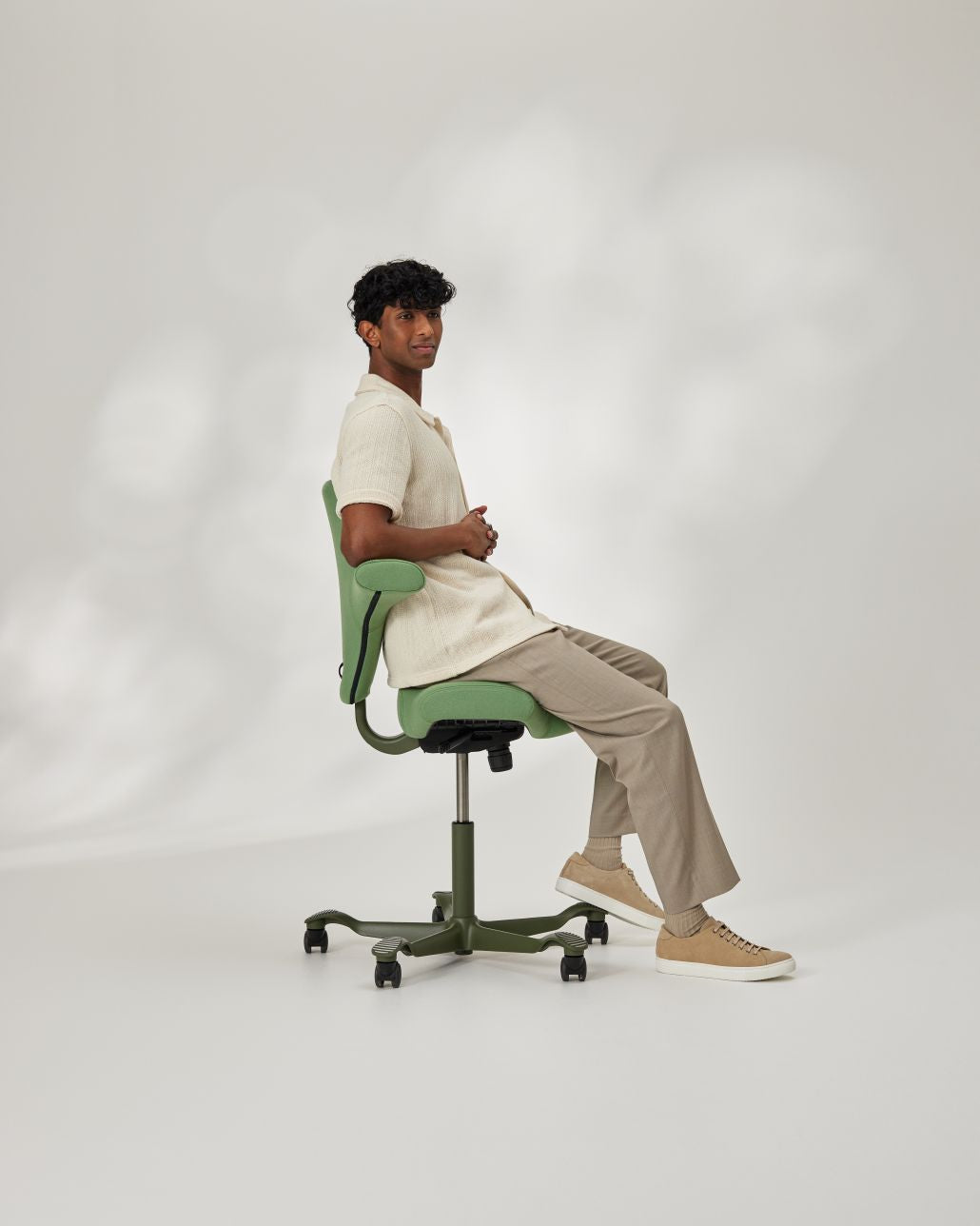 The saddle shape lets the pelvis tilt forward, opening the hip angle further than a conventional flat seat allows.
The Capisco's saddle-shaped seat lets your pelvis tilt forward rather than rolling backward, which is what a flat seat encourages. The result is a more open hip angle than a conventional office chair produces, and a lumbar curve closer to the one your spine holds when you stand.
Practically, that means less of your upper body weight is carried through a slumped lower back, and it is easier to move — to shift forward onto the front of the saddle, to sit reversed, to swing a leg. The Capisco is a chair for changing position, not for holding one.
Raising the seat extends the effect. As the seat goes up, more of your weight transfers to your legs and the hip angle opens further, until at the top of the 265mm lift you are perching rather than sitting. That is the reason the gas lift choice matters so much: it is not just a height adjustment, it determines which postures the chair can actually produce.
Comparing the three lifts side by side
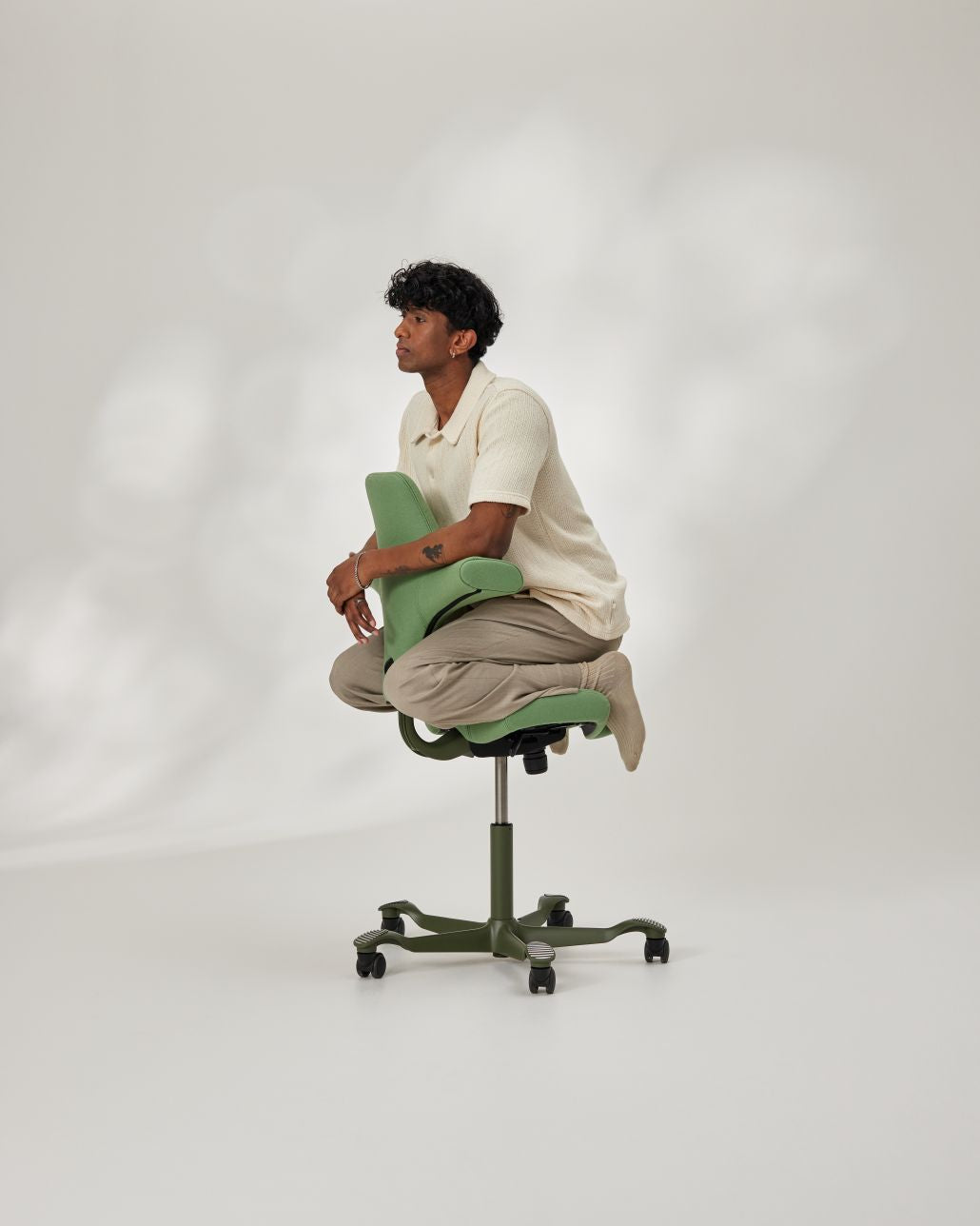
200mm lift
460 to 640mm on the 8106. Seated work at a fixed desk.
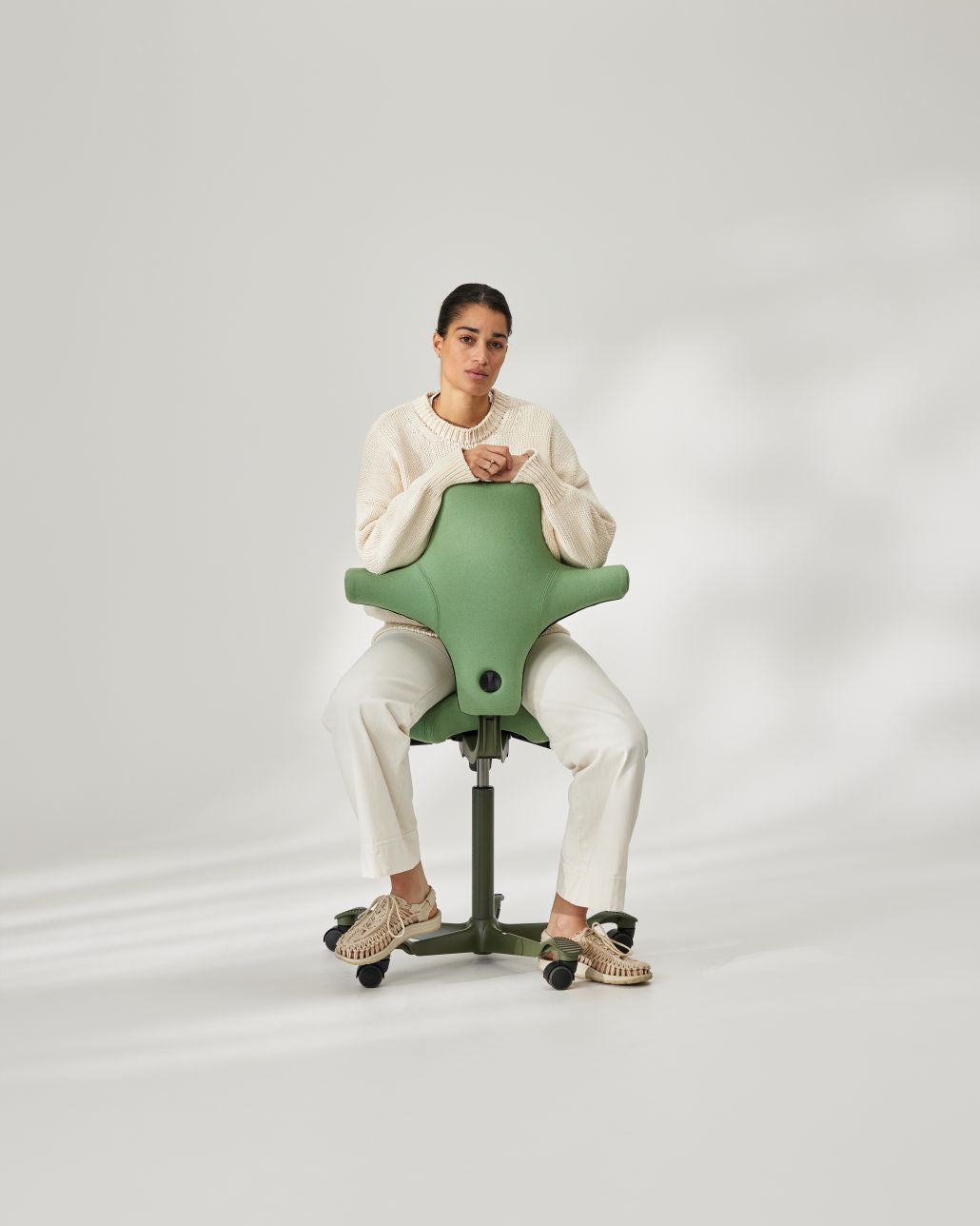
265mm lift
550 to 810mm on the 8106. Perching at a raised desk.
| Feature | 150mm lift | 200mm lift | 265mm lift |
|---|---|---|---|
| Seat height, 8106 / 8107 / 8126 / 8127 | 400 – 540mm | 460 – 640mm | 550 – 810mm |
| Seat height, 8105 backless | 380 – 520mm | 440 – 620mm | 530 – 790mm |
| Typical desk | Low fixed desks, under about 70cm | Fixed desks around 70 – 75cm | Sit-stand desks and raised benches |
| Perching | No | Partial, at the top of the range | Yes, to 810mm |
| FootRing available | No | Yes | Yes |
| HAG StepUp | Not required | Optional | Recommended |
| Best for | Shorter users and low desks | Conventional office and home desks | Dynamic sit-stand, labs, clinics, studios |
Real-world scenarios
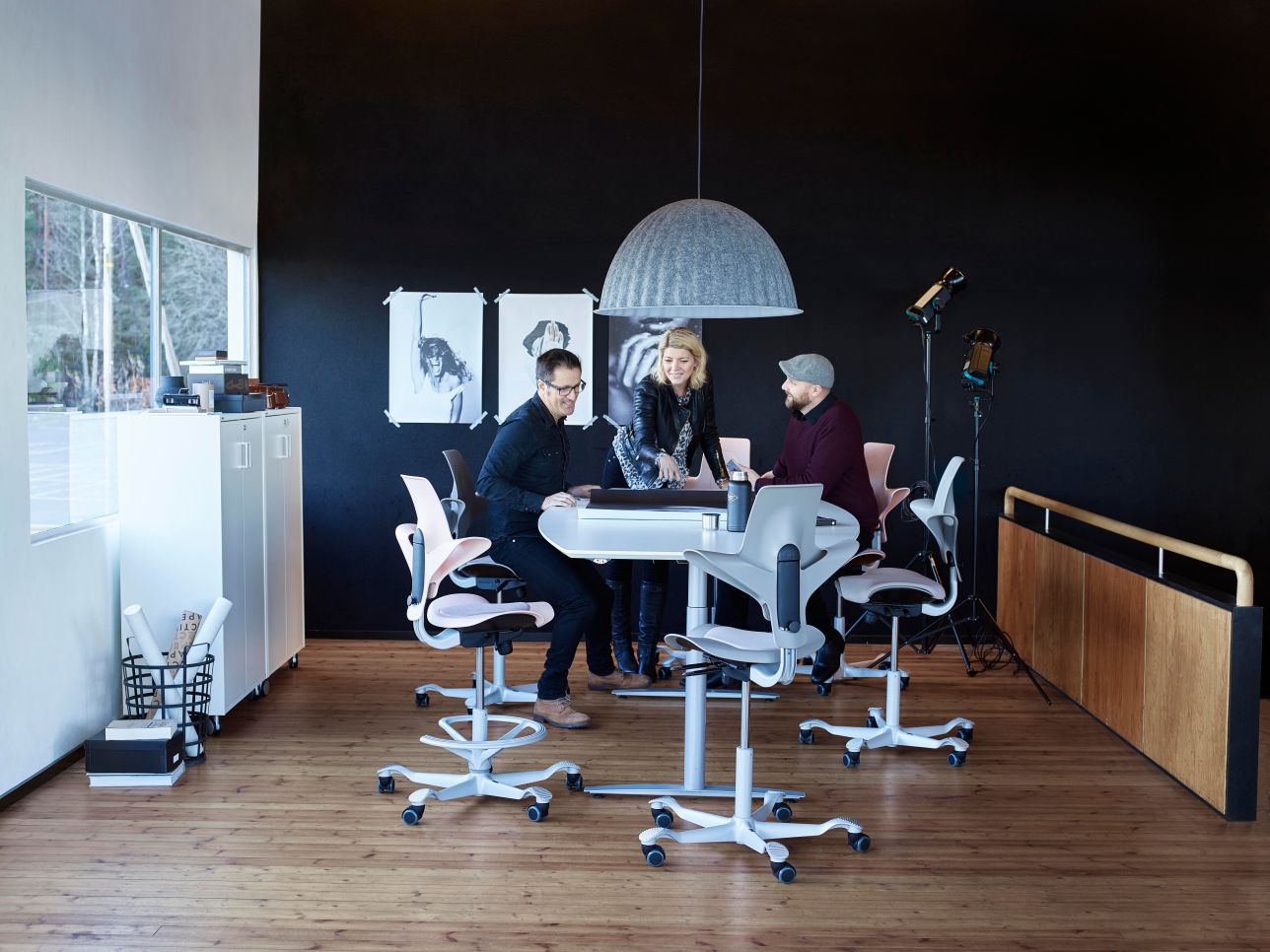 In a shared office, colleagues at identical desks often need different gas lifts.
Scenario 1 — home office with a fixed 72cm desk
Your desk is fixed at 72cm and is not changing. Your comfortable seat height is around 500mm. The 200mm gas lift is the fit: 500mm sits inside its 460–640mm range on an 8106, with adjustment available in both directions for forward-leaning and reversed sitting.
Scenario 2 — corporate office with sit-stand desks
Your workplace uses height-adjustable desks from about 68cm to 120cm, and you want to alternate between sitting and perching. The 265mm gas lift is the only lift that follows the desk up: 550 to 810mm on an 8106. Pair it with a FootRing or a StepUp so your feet have somewhere to go at the higher settings.
Scenario 3 — dental clinic or laboratory bench
A raised bench or treatment position needs seat heights in the 600 to 750mm region. The 265mm gas lift covers this comfortably; the 200mm lift's 640mm ceiling does not.
Scenario 4 — musician, artist or drafting table
An easel, upright piano or drafting board needs height plus freedom to move. The 265mm gas lift supports the perched positions that keep you mobile, and the saddle lets you turn and reach without leaving the seat.
Scenario 5 — a shorter user at a fixed desk
You are on the shorter side, your desk is fixed and slightly low, and a 200mm lift will not drop far enough for your feet to sit flat. The 150mm gas lift takes an 8106 down to 400mm, and an 8105 down to 380mm. This is exactly the case the 150mm lift exists for, and it is the one that most guides never mention.
Changing the gas lift later
The gas lift on the HAG Capisco is a replaceable component, so a wrong choice is a fixable one and a change of desk does not mean a change of chair. Replacement lifts are available separately — see the HAG Capisco Gas Lift.
The swap itself is straightforward: lift the seat and column assembly off the base, remove the old gas lift, insert the new one, and refit the seat. Allow about five minutes. Gas lifts seat themselves firmly under load, so an older chair can need help separating — the HAG Gas Lift Unblocking Tool and the HAG Chair Disassembly Tool are made for this and are worth having if the chair has been in service for years.
Two things to remember when you change lifts. If you are moving down to a 150mm lift and you have a FootRing fitted, the FootRing will no longer be usable. And because the FootRing matches the lift colour, changing the lift colour means the ring will no longer match.
Accessories worth considering
To finish your HAG Capisco for your room and your floor:
- HAG Capisco 65mm Castors — for smooth rolling on hard floors
- HAG Capisco Glides — to hold the chair still on carpet, or where you do not want the chair to roll
- HAG Capisco FootRing — for 200mm and 265mm lifts, colour-matched to the lift
- HAG StepUp — Black or Silver, two additional foot levels
For the rest of the range, see our Accessories collection.
Warranty and everyday use
The Capisco carries a 10-year guarantee. The condition attached to it is worth reading before you order, because it is the clearest published statement of how the chair is intended to be used: the 10-year term covers normal use of up to 9 hours per day, for users up to 110kg. Where the chair is used for more than 9 hours a day — a 24/7 control room, a multi-shift clinical setting — the guarantee term is 5 years.
That is the whole of the published position. Flokk does not publish a maximum user weight for the Capisco, and we will not invent one; the 110kg figure above is a warranty condition, not a load limit. If your application sits outside those conditions, call us and we will tell you honestly whether the Capisco is the right chair for it.
Buying a Capisco in Australia
Chair Dinkum is the exclusive Australian distributor for the Flokk group, of which HAG is one of eleven brands. That means the chairs, the gas lifts and the accessories on this page come through the local distribution chain rather than a grey import, and it means the specifications on this page come from the current factsheet rather than an old brochure.
What that changes for you:
- Stock is held in Sydney. Gas lifts, footrings, castors and glides are here, not on a boat.
- All three lifts can be tried in our Pyrmont showroom. Fifteen minutes sitting on the right one settles the question better than any table, this one included. Bring the shoes you wear at work.
- Warranty is assessed locally. A claim is handled here, not routed offshore.
- Advice by phone. Call 02 9640 0642 with your desk height and your lower-leg measurement and we will tell you which lift to order.
Frequently asked questions
How many gas lifts does the HAG Capisco have?
Three: 150mm, 200mm and 265mm. Many guides describe only two, the 200mm and the 265mm, and omit the 150mm low lift entirely. All three are current options on the Capisco range.
What is the seat height range of the standard 200mm gas lift?
460 to 640mm on the 8106, 8107, 8126 and 8127. On the backless 8105 it is 440 to 620mm. It is the standard fit and suits fixed desks of around 70 to 75cm.
What is the seat height range of the 265mm gas lift?
550 to 810mm on the 8106, 8107, 8126 and 8127, and 530 to 790mm on the backless 8105. This is the lift required for perching and for sit-stand desks.
What is the 150mm gas lift for?
It is the low option, giving 400 to 540mm on the 8106, 8107, 8126 and 8127, and 380 to 520mm on the 8105. It suits shorter users, low fixed desks, and anyone who has found a 200mm lift will not drop far enough for their feet to rest flat on the floor.
Which gas lift do I need for a standard 72cm desk?
The 200mm lift in almost all cases. It covers 460 to 640mm on an 8106, which contains the seat height most people use at a 72cm desk. Choose the 150mm lift instead if you need the seat below 460mm.
Which gas lift do I need for a sit-stand desk?
The 265mm lift. It reaches 810mm on an 8106, which is high enough to perch at a fully raised desk. A 200mm lift stops at 640mm and will not follow the desk up.
Can I fit a footring to any Capisco?
No. The HAG FootRing is available for chairs with 200mm and 265mm gas lifts only. It is not available for the 150mm lift. The FootRing matches the colour of the gas lift, so order them together. The HAG StepUp, in Black or Silver, is an alternative that provides two additional foot levels.
Why does my chair measure higher than the published seat height?
Because published seat heights are measured with a load on the seat — test methods use a weighted load of roughly 64 to 65kg. An unloaded chair sits slightly higher, so a tape measure at home can disagree with the specification by a centimetre or two. This is normal and is not a fault.
Do the backless 8105 and the 8106 have the same seat heights?
No. The 8105 sits about 20mm lower on every lift: 380 to 520mm, 440 to 620mm and 530 to 790mm, against 400 to 540mm, 460 to 640mm and 550 to 810mm for the 8106, 8107, 8126 and 8127.
Are the Capisco Puls seat heights the same as these?
No. The Capisco Puls range — the 8001, 8002, 8010 and 8020 — has its own Flokk factsheet, published in millimetres rather than centimetres, and not one figure on this page applies to it. On the standard 200mm lift the Puls 8010 runs 455 to 640mm and the 8020 runs 470 to 650mm. Full figures for all four models are in our HAG Capisco Puls gas lift guide.
Can I change the gas lift on my Capisco later?
Yes. The gas lift is a replaceable component and the swap takes about five minutes: lift the seat and column off the base, remove the old lift, fit the new one and refit the seat. On chairs that have been in service for some years the HAG Gas Lift Unblocking Tool and HAG Chair Disassembly Tool make the job easier.
What is the warranty on the HAG Capisco?
Ten years, covering normal use of up to 9 hours per day for users up to 110kg. Where the chair is used for more than 9 hours a day, the guarantee term is 5 years.
Can I try the different gas lifts before I buy?
Yes. All three lifts can be tried in the Chair Dinkum showroom in Pyrmont, Sydney. Bring the shoes you wear at work and, if you can, the height of your desk. You can also call 02 9640 0642 and we will work it out with you over the phone.
Completing the workstation
The gas lift sets your seat height; the rest of the workstation has to meet it. If you are raising the chair, your screen has to come up too — our range includes the CBS Flo Single Monitor Arm and the CBS Flo Dual Monitor Arm, which let you keep the top of the screen near eye level whether you are seated or perched.
If you are pairing a 265mm lift with a new desk, see our Sit to Stand Desks collection. For other seating, browse our Office Chairs and Executive Chairs.
Our recommendation
Reversed, forward, perched — the Capisco is built for changing position rather than holding one.
If you use a sit-stand desk or a raised bench, order the 265mm lift. Nothing else reaches perching height, and the perching range is the reason most people buy a Capisco in the first place.
If your desk is fixed at around 72cm, order the 200mm lift. It is the standard for a reason, and 460 to 640mm covers the way most people work at that height.
If a 200mm lift will not go low enough for you, or your desk sits below about 70cm, order the 150mm lift. It is the least-discussed option and the correct one more often than the internet suggests — just remember a FootRing is not available with it.
Whichever you choose, the chair itself is identical. The gas lift determines the range; the Capisco does the rest.
Shop the Capisco range
- HAG Capisco Saddle Chair 8106 — the standard upholstered model, with over 40 fabric options
- HAG Capisco Puls Saddle Chair 8010 — moulded polypropylene (PP) seat and backrest with an integrated seat cushion, easy to clean
- HAG Capisco Puls Saddle Chair 8020 — the Puls with an extra seat cushion
- View all Capisco chairs
- HAG Capisco models and measurements — the full specification table for the 8105, 8106, 8107, 8126 and 8127
- HAG Capisco Puls gas lift guide — the same decision for the Puls range, where every figure is different
The Capisco Puls range (8001, 8002, 8010 and 8020) uses its own seat height figures, and they differ from every number on this page. We cover the Puls separately rather than repeat figures that do not apply to it — see the HAG Capisco Puls gas lift guide for the published seat height of all four Puls models against all three lifts. Note that Flokk publishes the Puls in millimetres and the Capisco in centimetres, so read the two tables carefully rather than side by side.
Still not sure? Contact us or call 02 9640 0642 with your desk height and your lower-leg measurement, and we will tell you which lift to order.


